
Why Main Street “practical” businesses?
Venture capital doesn’t see the appeal. No local plumber is going to be the next Google – there’s no 10,000x on Main Street. Pouring tens of millions into tech companies that might become a unicorn but will probably burn out fast and fail… that’s their whole model: 99 failures and one massive success. You can’t throw tens of millions at a plumbing company and turn it into a billion-dollar business in three years.
So let’s put traditional venture capital aside. They don’t even remotely fit this space.
Private equity absolutely sees the appeal. Buying a thriving local plumber and consolidating twenty other plumbers under that brand, leveraging the whole thing, saddling the plumbing firm with massive debt while the PE firm cashes out and walks away… that’s the industry’s preferred model.
It’s sordid by design – but it doesn’t have to be.
Private equity sees what venture capital doesn’t. A local plumber can be very profitable. The owner’s business operations knowledge can be codified and scaled quite readily. If we put aside the company-killing debt PE firms love and forget about a quick exit, what we have is a company that was doing great and that is ready to grow from local to regional, and then from regional to national.
Let’s talk numbers
Let’s take one of the companies we’ve looked at recently – not a plumber, but completely practical and service-based in exactly the same way. Call it Bob’s Main Street and leave it at that.
Bob’s has a great system. It’s been operating at just about $300,000 top line and $75,000 net (after the owner/operator is paid) for the past five years.
Bob’s has a system. Bob’s is banking a solid 25% margin year after year.
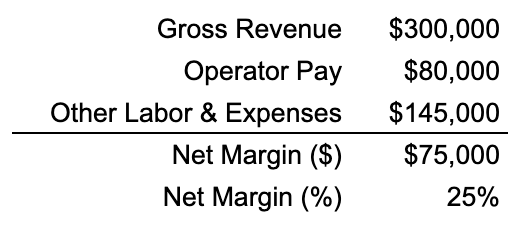
What Bob’s lacks is growth. $300,000 one year is great. $300,000 the next year tells us that Bob’s may have maxed out, at least with operations as they stand currently. Five years on? There is clearly something keeping Bob’s from growing right now.
It turns out in this particular case, the problem is that Bob’s rents a small spot and employs a few people, and the space is maxed out. Bob’s would need a larger space to bring in more revenue. Or multiple spaces.
If Bob’s has a good thing going – and their Google reviews and customer retention show us they do – then is there a way to repeat Bob’s process? To double it so his net is $150,000. Or to 10x it, so his net is $750,000?
Taking a business that clears $75,000 and adding another zero by just copy-pasting a winning model: that by itself wouldn’t be bad for a modest investment and three years’ work. But as you can imagine, we know we can do a lot better.
Our model is just what Bob’s needs
One of the ways Benevolent helps companies before we ever invest capital is we help them solve a number of process puzzles so their existing companies are running more effectively and so they are best able to scale fast.
Every company has its own lowest hanging fruit that we identify and help them fix, and Bob’s is no different.
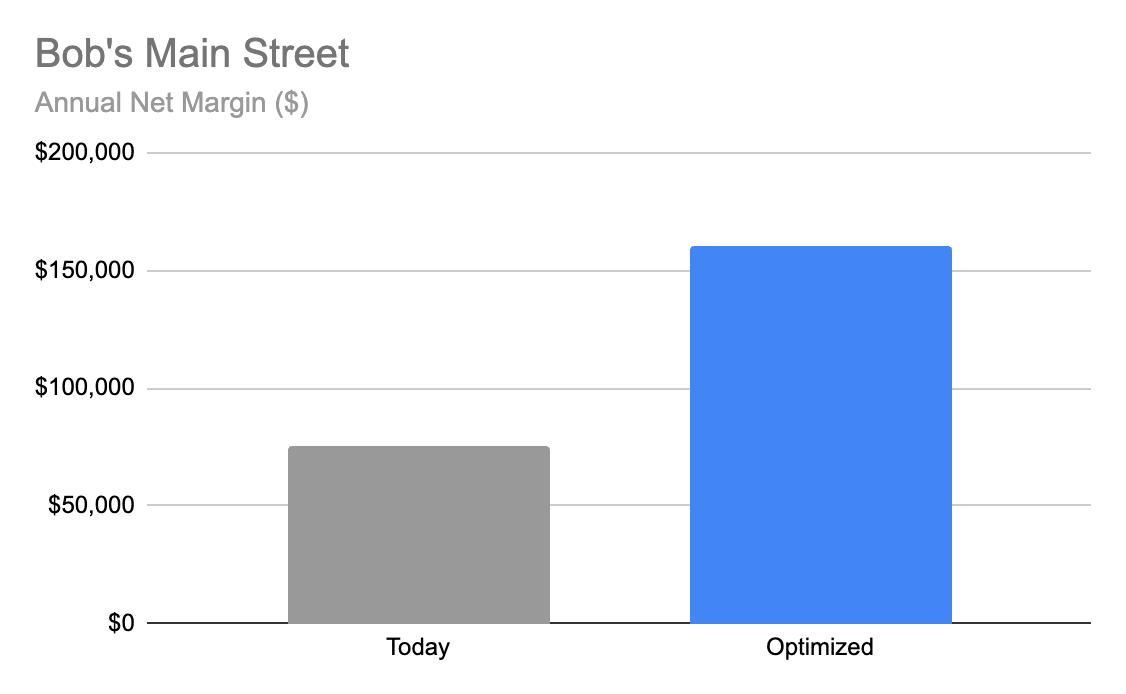
Let’s say, for sake of argument, we can help Bob’s owner, Robert, reduce some inefficiencies and also upcharge clients for some services they are eager for. That alone could turn Bob’s $300,000 location into a $400,000 location, and it could increase the net from 25% to 40% - especially easy if we keep Robert on a fixed salary, so his portion of payroll doesn’t eat into that “found” $85,000.
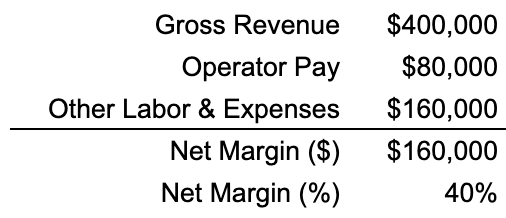
In three months, Bob’s is on track to net $160,000 this year.
Next, our due diligence for Bob’s has confirmed something he told us in early exploratory meetings: His next location can handle double the volume of business. All he needs is a rental space that is twice as large. He already has the talent on-staff to run his first spot while he onboards a new crew at the second location.
This new location will net $320,000 its first year, even if nothing else is improved. Together with the first spot, that’s $480,000 profit with just two locations, a far cry from the ten locations we first discussed with Robert.
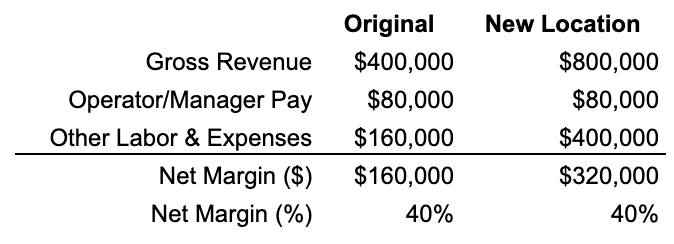
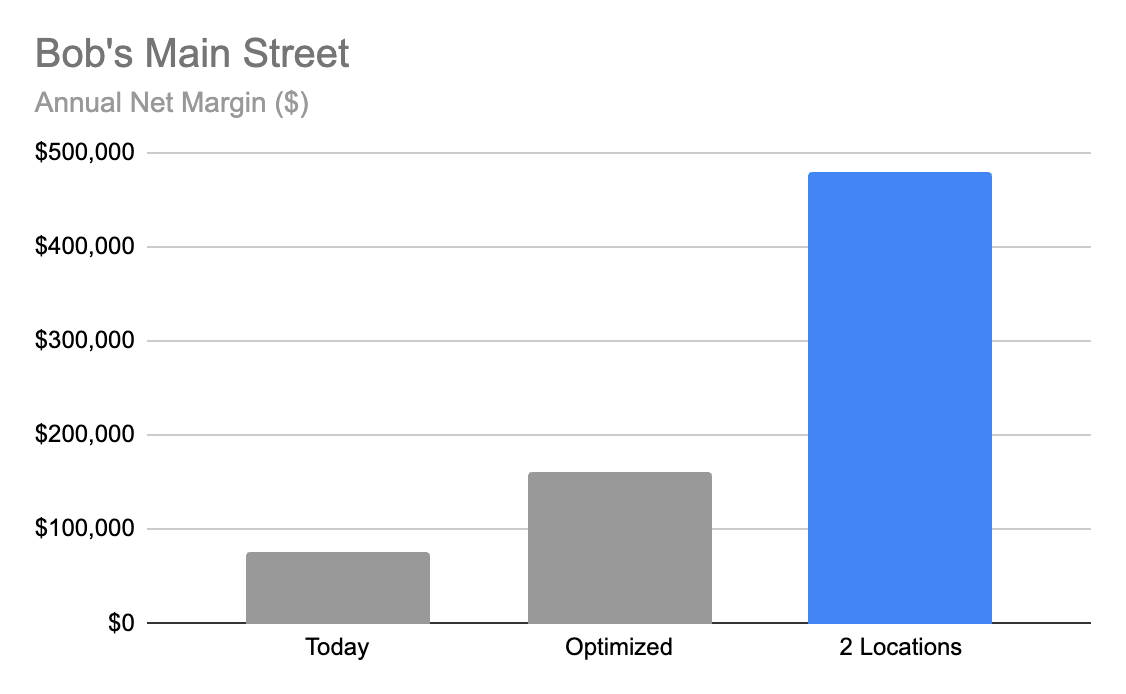
Let’s do some more math. To keep it simple, assume Bob’s moves its first location into a larger spot, so it is generating the same revenue as its newer branches.
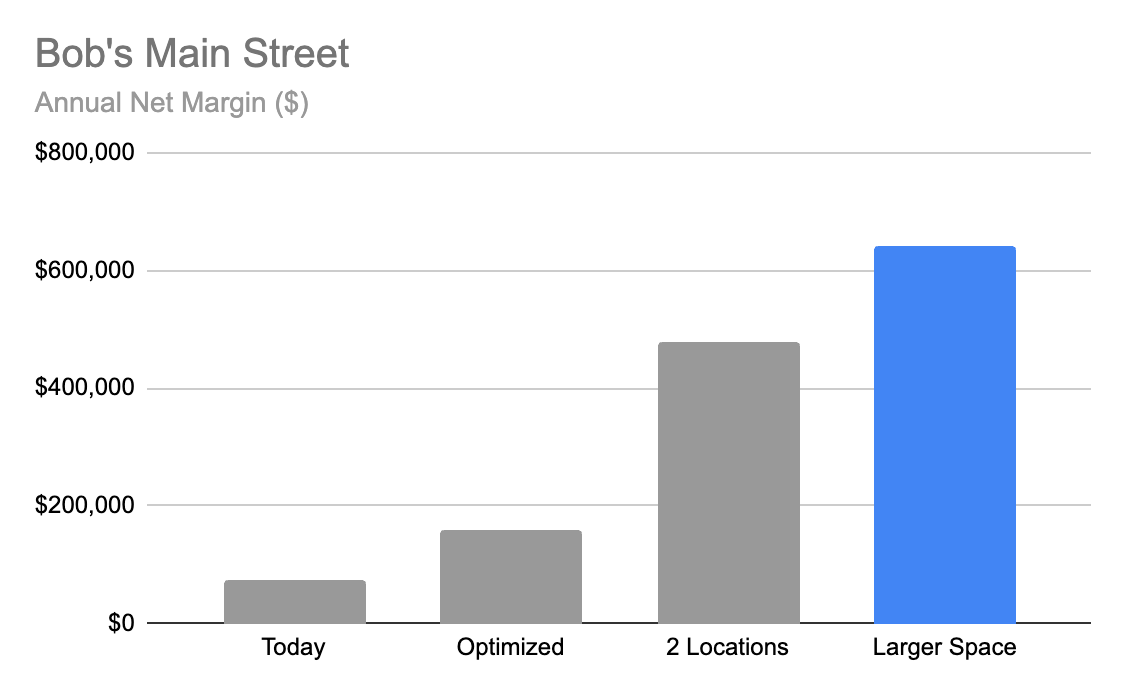
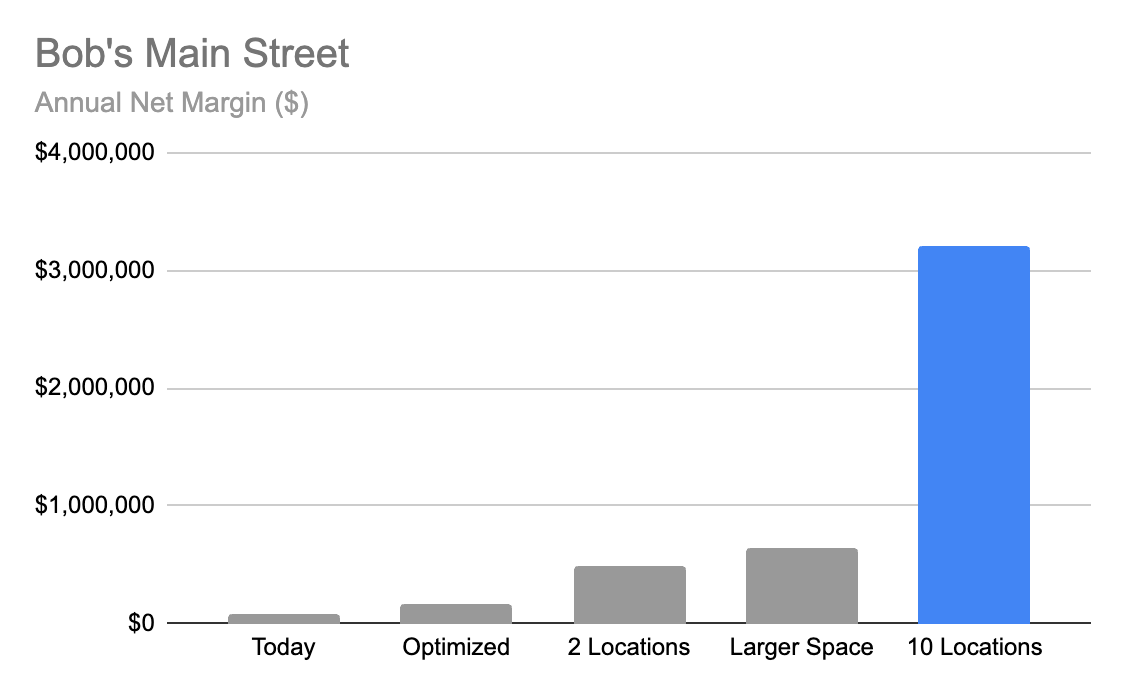
Now we leverage the experience of Benevolent’s principals and mentors to build a strong and scalable system for Bob’s, such that over the next three years, Bob’s is in 10 new spots, each bringing in $320,000. As a business, Bob’s is now netting $3.2 million annually.
Bob’s is ready to become a franchisor. Working with the Benevolent mentors who have successfully built franchise businesses of their own, the next five years sees Bob’s in ten states and growing, with thirty locations and growing – in addition to its own corporate locations.
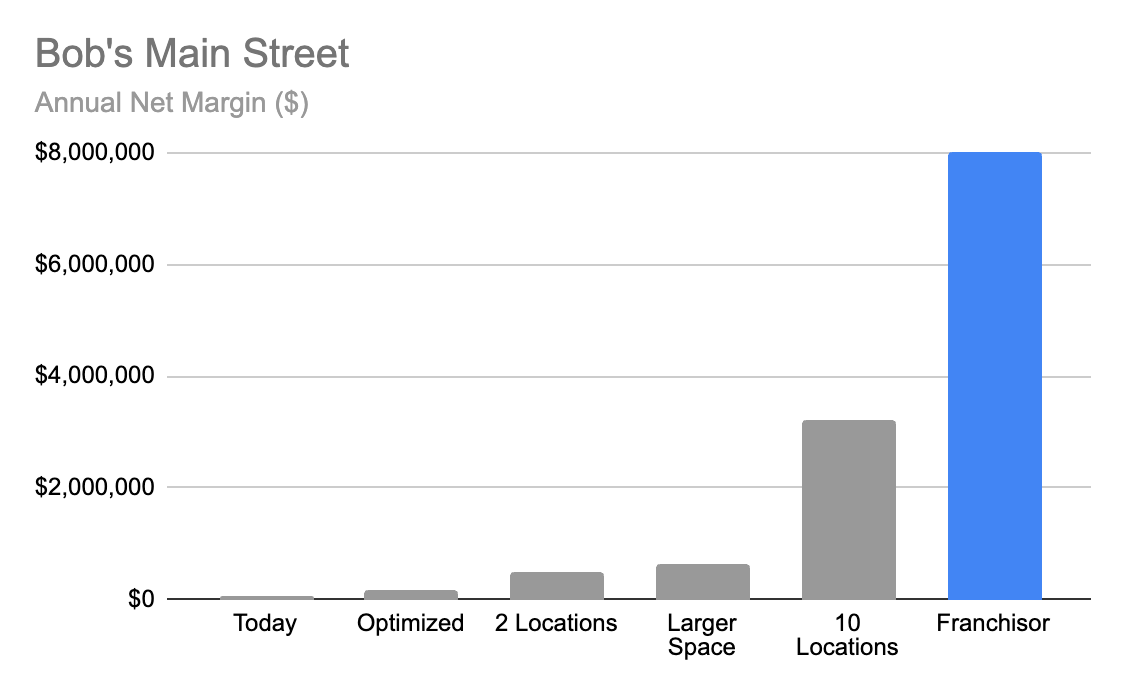
The beauty of the Benevolent model is its simplicity; each step is tested on its own merits, following the principles of The Lean Startup and The E-Myth. This model builds on successes, and leaves room for pivots along the way; just as trying to franchise Bob’s from day one would kill the business, so too would be to assume that growth is only “up and to the right”.
Know a founder with a system that works but no room to grow? Tell us about them. Applications are open year-round and reviewed on a rolling basis.